Film Review
Hoppers
Piper Curda · Bobby Moynihan · Jon Hamm
A film about a college student who transfers her consciousness into a robotic beaver so she can talk to animals could go a hundred ways. Daniel Chong sends it somewhere stranger than the logline promises. The governing idea of Hoppers, the studio-anchoring principle its own makers name, is that comedy comes first and everything else gets built on top of it. That reversal is the whole personality of the picture, and it explains both what works and what strains.
Editorial Deep
Score breakdown, defended
Each dimension scores what it scores. The number is the claim; the prose is the defense.
Editorial Layer
Flat mean of the five dimensions below. Contributes 65% to the Skry Score.
The screenplay commits to a bold structural inversion, building the story on comedy as its load-bearing element and letting absurdist logic drive the plot. The 'pond rules' conceit is a genuine invention, a social system that generates jokes and stakes at once. But the seams show where it counts. The environmental material sits loosely against the comedy rather than growing out of it, and the emotional beats arrive on a schedule that feels dutiful rather than earned. The final act trades coherence for velocity, tangling its body-swap reversals past the point of clean legibility. Real wit and real invention, undercut by connective tissue that doesn't always hold.
The visual grammar is doing deliberate, legible work. The design language shifts from restrained, small-eyed naturalism to rounder cartoon exaggeration as Mabel's understanding of the animals deepens, so the style tracks character rather than decorating it. The lighting is bolder still: a theatrical, illogical 'stage' approach that pushes the Animal Council's arrival into horror-adjacent stylization, reaching for the tonal instability of Gremlins and Beetlejuice. Translating a flat-composition television comic sensibility into a moving 3DCG camera is a real problem, and the film mostly solves it, staging its full-tilt action set pieces with genuine command. The seagull-borne shark and the wildfire sequence prove the camera can carry both lunacy and scale.
This is the film's most secure achievement. Piper Curda gives Mabel fierce energy and a warmth that keeps a flawed, wrong-headed protagonist sympathetic, holding the through-line of a crowded movie on her voice alone. Bobby Moynihan's King George lands both laughs and heart, and the chemistry between the two anchors the film's best scenes. The deep bench delivers: Dave Franco's moth-king Titus supplies the horror-tinged comic edge, Jon Hamm's Mayor Jerry works as a foil rather than a villain, and Isiah Whitlock Jr.'s Bird King is among the Council's sharpest inventions. Even Streep's Insect Queen serves the film precisely by how her role is used. The vocal ensemble is uniformly alive; the performers commit fully to the absurdity the film demands.
The film's rhythm is built on comic endurance, running gags past conventional timing until the persistence itself becomes the payoff. When it commits fully, the effect is exhilarating, and the peak action set pieces carry real momentum. The final third accelerates hard, stacking reversals and set pieces, and the wildfire sequence lands a genuine emotional charge as the fiction and the real stakes blur. But the pacing is uneven by design, and the endurance gags that thrill some viewers lose others entirely; the slower emotional passages sometimes stall the drive rather than deepening it.
There's real texture to return to: the design shift keyed to Mabel's arc, the stage-lighting stylization, the density of comic invention in the Council. The shock beats and the tonal instability reward a second, calmer look. But the film's biggest swings are front-loaded on surprise, and the tangled final act offers diminishing clarity rather than new depth on rewatch. It's a movie whose ambition invites revisiting and whose looser thematic stitching becomes more visible the second time through.
Chong builds a rule, insists you revere it, then squishes it for a laugh; that nerve is the whole personality of the picture.
Chong comes to features from television animation, where jokes live in flat compositions and precise storyboard timing. You can feel that lineage translated, sometimes uneasily, into a moving 3DCG camera. His instinct is to run a gag past the point of comfort and see what happens on the far side of it. The animals' loud-noise imitation sequence is the clearest test case: a single bit stretched well past conventional timing until endurance itself becomes the joke. It either lands for you or it doesn't. That is the film's method in miniature.
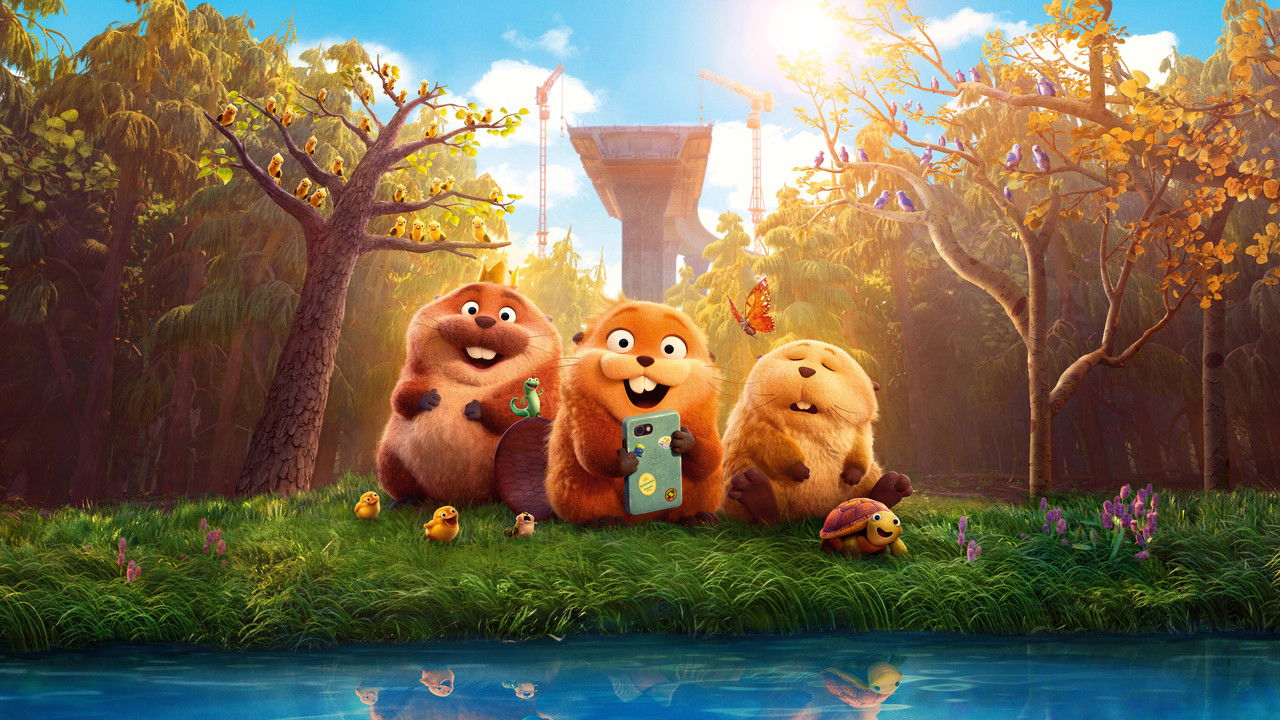
The visual grammar is doing quiet work most viewers won't consciously clock. Early on, the animals are drawn with small dark eyes and restrained features, closer to observed wildlife. Once Mabel hops into her beaver bot and begins to understand them, the design language loosens into something rounder and more cartoonish. The shift tracks a change in her relationship to the world rather than merely decorating it. There is a companion trick in the lighting. Chong cites early Tim Burton and reaches for a 'stage' quality where illumination doesn't obey logical rules; the Animal Council's arrival is pushed into a theatrical, horror-adjacent register that has nothing to do with where the light would actually fall. The stated ambition is a tone as slippery as Gremlins or Beetlejuice, funny and scary and sad at once, with action closer to Mad Max than to the usual family register. That is a lot of tonal plates to keep spinning, and the film is candid about wanting them all in the air simultaneously.
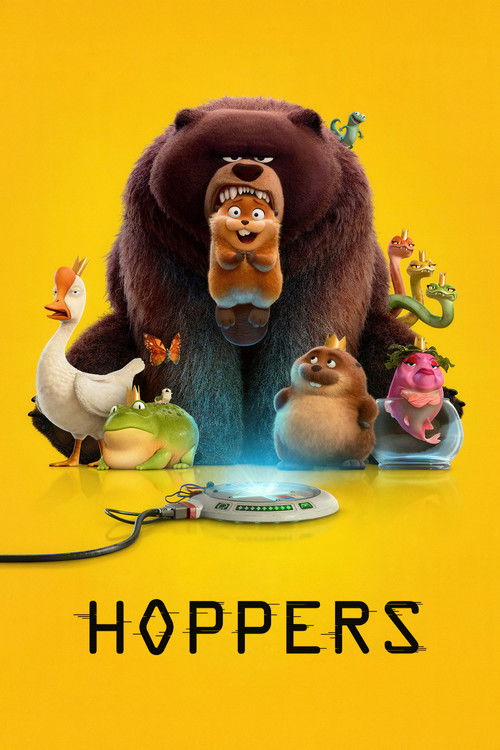
The voice cast is the surest thing here. Piper Curda gives Mabel fierce energy and a genuine warmth, playing a character with the right intentions and the wrong methods, which is a harder note to hold than pure heroism. Bobby Moynihan's King George slots in beside her with easy chemistry, comic and tender in the same breath. Around them sits an unusually deep bench: Jon Hamm's Mayor Jerry works as a foil and occasional voice of unwelcome realism rather than a villain, and the Animal Council fills up with sharply drawn oddities, including a goose Bird King voiced by Isiah Whitlock Jr. in one of his final roles.
The last third is where the film either exhilarates or loses you. It shifts into a faster, busier mode, stacking action beats and reversals, and the machinery of who-is-in-whose-body gets genuinely tangled. Younger viewers may lose the thread. The trade is intensity for legibility, and Hoppers takes that trade willingly. The environmental stakes, meanwhile, are real enough that the science-fiction conceit and the actual world start to bleed together in the film's penultimate stretch, which is also its most affecting.
I'll say only that the film is at its best when it commits fully to its own weirdness and least persuasive when it slows down to deliver the expected emotional beat on schedule. Whether that ratio works for you is the entire question, and it is a live one. Reasonable, attentive people are landing on opposite sides.
Beyond this line, spoilers
The Conversation
First-person welcome. Pushing back on consensus is a tool, not a formula.
Let me start with the moment everyone is going to talk about. Meryl Streep voices an Insect Queen butterfly established as the untouchable, all-powerful center of the Animal Council, and then the film simply squishes her, impulsively, without ceremony. In at least one theater it produced dead silence and then helpless laughter, and I understand exactly why. It is the single most Chong decision in the movie: build a rule, establish the reverence, and then violate it as a punchline. If you love Hoppers, you probably love it for the nerve of that beat. If you don't, it reads as shock substituting for wit.
That divide is the real story of this film's reception, and I don't think it's confected. On one side you have people convinced this is the best original thing the studio has produced in years, something that feels like classic work in the ways that matter. Christian Ramos lands near there, hopeful it makes audiences clamor for original ideas again. On the other side, a serious voice like Roger Moore reports chuckling once, maybe twice, in the first forty-five minutes, and watching a preview-night child audience drift. Moore's argument is pointed: you assemble two of the funnier people to come out of Saturday Night Live in decades, plus Streep, and you hand them nothing especially funny to play. Scott Mendelson goes further, framing the enthusiasm as overreaction to a long stretch of diminished output.
I find the comedy question harder to settle than either camp allows. Courtney Howard is right that the film is at its best in full-tilt-berserk mode. The flying shark set piece, in which the absurdly round great white Diane gets carried aloft by seagulls, is exactly the kind of committed lunacy the film does well. The 'pond rules' conceit, the animals' internal social logic, is both a clean comic engine and a real idea. And Dave Franco's hyper-violent moth-king Titus lets Howard's 'dipping into horror a little' become a genuine tonal color rather than a garnish. But the endurance gags genuinely do run long by design, and 'by design' isn't a defense to a viewer who checked out at minute three.
On theme, I lean toward the skeptics more than the boosters. The wildfire sequence, where an animal using the hopping tech goes rogue, is where Rachel Bowie locates the film's true poignancy, and I agree it's the strongest emotional passage. But it also exposes how loosely the environmental material is stitched in elsewhere. Emily Tsiao finds the messaging weak relative to the studio's better work, and the harshest reads call the ecology an accessory rather than a foundation. I wouldn't go as far as 'emotionally hollow,' but the slower emotional beats do sometimes feel installed to satisfy an expectation rather than because the story demanded them there.
There's a thornier conversation underneath all this about what the film tells kids. Some readings find a secondary message to young activists that reads as tone-deaf, and audience commentary has run with an anti-authority interpretation: don't listen to your parents, your teachers, or the king, just follow your feelings. Jon Hamm's Mayor Jerry is supposed to be the corrective, the voice of social realism against Mabel's righteous anger, though one reviewer flags that framing as the film's most unrealistic element. I think the movie is more ambivalent than its loudest critics allow, but the ambivalence isn't fully controlled, and I'd want to sit with it again before deciding whether the film knows what it's arguing.
What I keep returning to is the ambition. Chong wanted Gremlins-level tonal instability with cute animals and Mad Max action, and he mostly got it. The film made a real amount of money and clearly connected. Whether it's a return to form or another data point in a slump is, I suspect, a question that says as much about the person answering as about Hoppers itself. Curda's Mabel is the thing I'm surest of. That performance is the through-line holding a very busy movie together.
Cast & Crew
Who made it, and who’s in it.
Cast
- Mabel (voice)Piper Curda
- King George (voice)Bobby Moynihan
- Mayor Jerry Generazzo (voice)Jon Hamm
- Dr. Sam (voice)Kathy Najimy
- Insect King (voice)Dave Franco
- Loaf (voice)Eduardo Franco
- Nisha (voice)Aparna Nancherla
- Tom Lizard (voice)Tom Law
- Conner (voice)Sam Richardson
- Ellen (voice)Melissa Villaseñor
- Bird King (voice)Isiah Whitlock Jr.
- Amphibian King (voice)Steve Purcell
Crew
- DirectorDaniel Chong
- ScreenplayJesse Andrews
- Director of PhotographyJeremy Lasky
- EditorAxel Geddes
- Original Music ComposerMark Mothersbaugh
About the Editor
Derik Silva
Editor-in-Chief
Derik founded The Skry to do for film and television what aggregator culture stopped doing — read closely, score honestly, and defend the score in writing. He believes the long arc is the only arc that matters: the films that earn their reputation by holding up over years, and the ones whose reputations have grown larger than the films can carry. Previously, he founded Travault.